
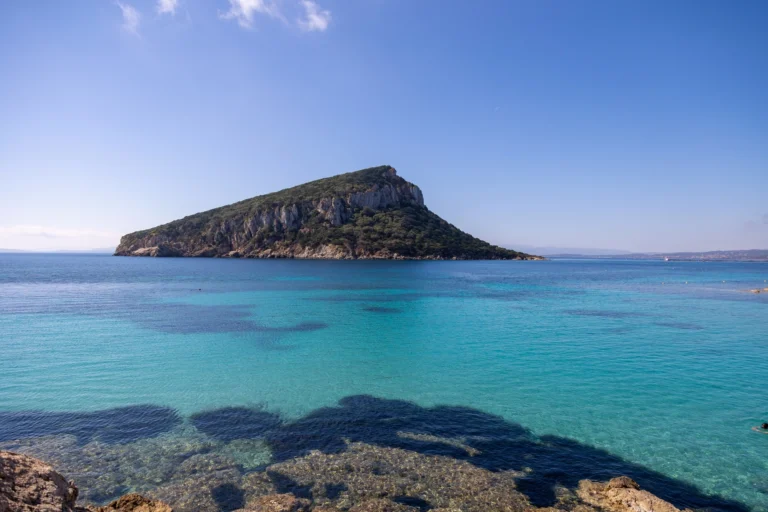
Figarolo It is one of the most recognisable landmarks on the Golfo Aranci coast: a small islet with an unmistakable silhouette, suspended between the sea, history and nature. Situated off the coast of Cala Moresca and near Capo Figari, this corner of Sardinia offers a landscape of crystal-clear waters, rich seabeds, limestone cliffs and views that remain etched in the memory.
This article is intended for anyone who wants to find out more about the’Figarolo Island, to understand why it is considered a true a place close to one’s heart and find out how to include it in an itinerary taking in Golfo Aranci, Cala Sabina, Tavolara and the north-eastern coast of Sardinia. It is a useful guide for anyone who loves the sea, hiking, photography, ancient history and unhurried experiences in the great outdoors.
What will we find out about Golfo Aranci, Figarolo and Capo Figari?
In this guide, we’ll be discussing where it is Figarolo, because of its distinctive shape, what links it has with Capo Figari, what to see in the surrounding area and what experiences to enjoy by sea. The article also includes references to Cala Moresca, Cala Sabina, Baia Concas Caddinas and Tavolara, thus offering a comprehensive overview of the area.
The sections are organised as questions to help you find the most useful information straight away. You’ll discover why the island is important from a nature conservation perspective, what historical artefacts have been found, what makes the surrounding seabed so special, and why this part of Gallura is worth more than just a quick photo stop.
Where is Figarolo, and why is it so closely linked to Golfo Aranci?
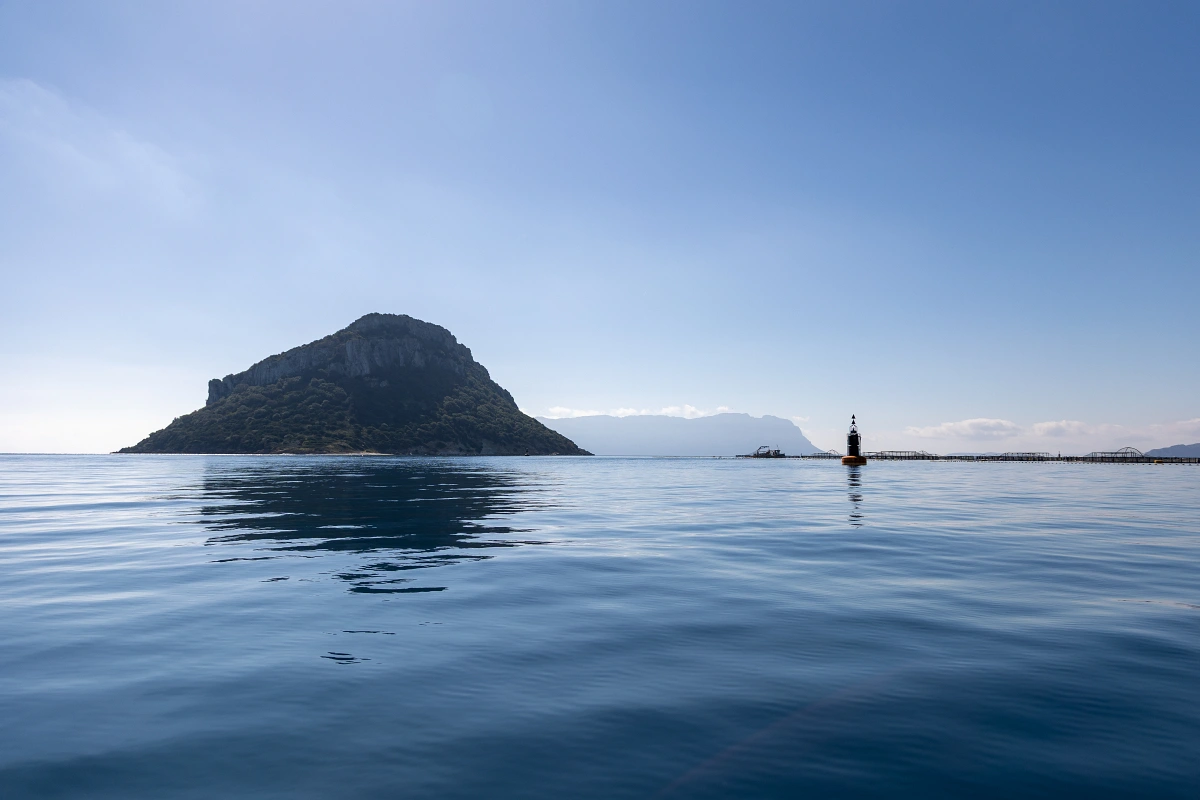
Figarolo is situated off the coast of Golfo Aranci, at the very north-eastern tip of Sardinia. The island is a constant feature of the seascape: it can be seen from the coast, from the footpaths at Capo Figari and from various vantage points along the coastline. Its location makes it a natural landmark for anyone exploring this part of north-eastern Sardinia.
The link with Golfo Aranci is strong because the islet forms part of a coastal landscape rich in coves, headlands and sheltered waters. From here, the view opens out towards the Gulf of Olbia, towards Olbia itself and towards some of the most fascinating stretches of coastline. The presence of Figarolo helps to make the landscape more distinctive, almost like a visual signature of the area.
Why does the island of Figarolo have such a distinctive pyramid-like shape?
The’Figarolo Island It immediately catches the eye because of its pyramidal shape, which rises out of the sea with a compact and striking silhouette. This silhouette is one of the reasons why the island is often photographed by Cala Moresca, from the scenic footpaths and from boats sailing along the coast.
From a geological point of view, the island is characterised by calcareous and is deeply rooted in the history of the area. Its profile stems from a Mesozoic limestone bank resting on a schistose basement, a feature that contributes to its landscape identity. The result is a small limestone plateau which, when viewed from the sea, almost resembles a natural pyramid.
His curious pyramid-shaped form It is partly reminiscent of other coastal landscapes in Sardinia, and is often described as similar to the island of Tavolara. Although much smaller than the island of Tavolara, the island is remarkably picturesque, especially when the morning or evening light outlines its contours.
What is the connection between Capo Figari and Figarolo?
Capo Figari and Figarolo together they form a landscape and natural environment of great value. The headland overlooks the coast with its cliffs, footpaths and vantage points, whilst the islet lies a short distance away, like a maritime outpost off the mainland. Together, they create one of the most evocative scenes in Gallura.
The headland Capo Figari is renowned for its unspoilt natural beauty, its hiking trails and its views overlooking the sea. From its heights, one can see the island of Figarolo in all its glory, together with the sea that separates the coast from the islet. This visual connection makes the area perfect for those who enjoy walking, taking photographs and taking in the scenery.
The area is also important from an environmental point of view: the SIC Capo Figari It protects an area where terrestrial and marine habitats coexist. It is precisely this combination that makes the stretch between Capo Figari and Figarolo such a precious place, to be visited with respect and care.
How do you get to the island of Figarolo, and how do you go about visiting it?
Visit on the island of Figarolo It’s not like getting to a city beach or a resort with direct access from the mainland. The islet can be reached by sea and, generally speaking, only by small boats. This helps to preserve its secluded character and keep intact the sense of a place suspended between water, rock and silence.
When it comes to excursions in the area, it is important to remember that nature should be observed without disturbing it. Visiting the island means respecting sea conditions, local rules and the balance of the environment. It is not always necessary to go ashore: often the most beautiful experience is admiring the island from a kayak, a boat or a vantage point on the coast.
For those who wish to experience the sea at a leisurely and sustainable pace, a paddle along the coast of Golfo Aranci offers the chance to observe the island of Figarolo from a different perspective. Approaching from the sea reveals details that are missed when viewed from land: cliffs, ravines, the colours of the water and the interplay of light and shadow.
What is there to see near Cala Moresca, opposite Figarolo?
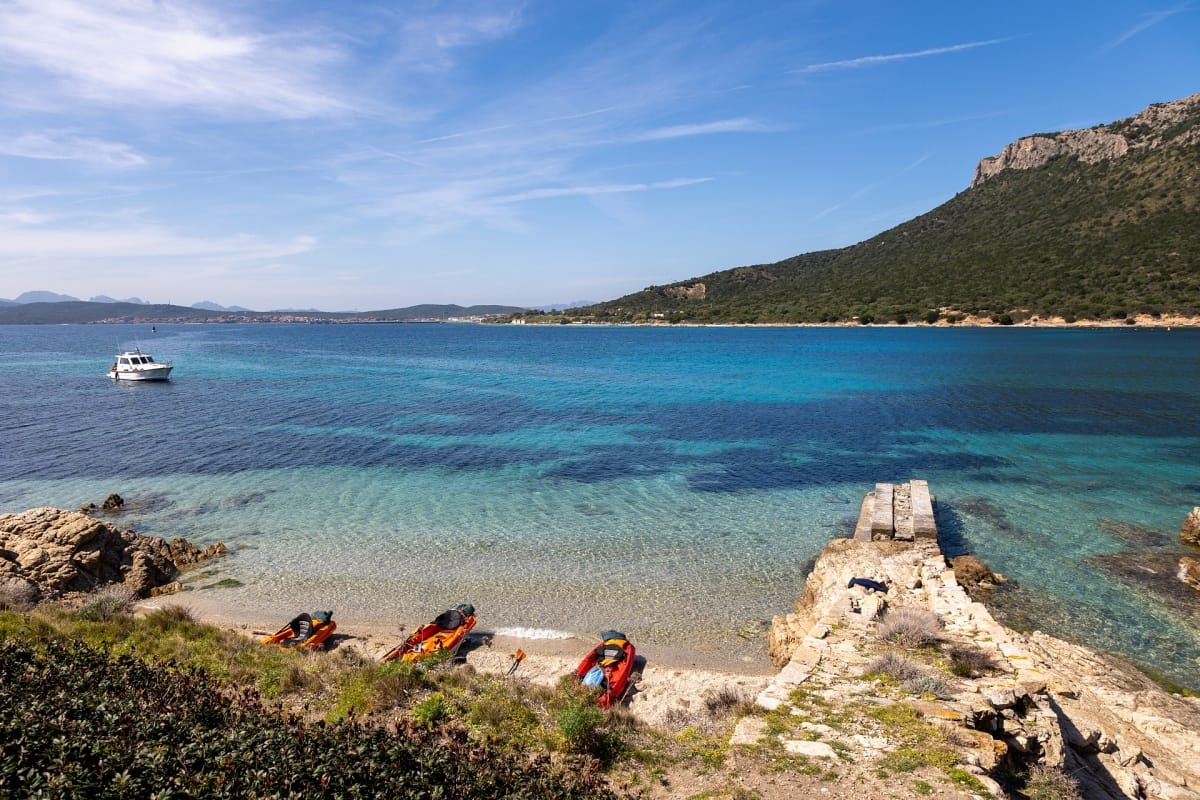
Cala Moresca It is one of the best spots from which to admire Figarolo. The cove is situated opposite Cala Moresca, in a setting where the sea takes on crystal-clear hues and the coastline appears intimate and picturesque. From here, the island seems close by, almost an integral part of the bay.
The beach is small, sheltered and surrounded by Mediterranean countryside. It is the ideal spot for a break, a swim or setting off on a boat trip. The seabed Near the coast, the water is crystal-clear and invites you to observe marine life with a mask and snorkel, whilst always taking care not to disturb the environment.
Visitors to Cala Moresca can round off their day with a walk to Capo Figari or a kayaking trip. This way, the experience isn’t limited to the beach, but becomes a journey along the coast, out to sea and taking in the views towards the islet.
Why are the surrounding seabeds so popular with diving enthusiasts?
I surrounding seabed In Figarolo, they are appreciated by diving enthusiasts for the variety of marine environments. The transition between rocky outcrops, submerged walls and deeper areas creates fascinating habitats, where the sea reveals its colours, shapes and marine life. A’dive This area offers some truly picturesque views, especially for those who are already familiar with the Mediterranean and wish to explore a stretch rich in biodiversity.
Among the most fascinating elements, the following are often mentioned submerged caves, coral, black corals, lobster, sponge, sponges and gorgonians. The gorgonians In particular, they create elegant scenes, whilst the presence of organisms attached to the rock speaks to the quality and complexity of the marine environment.
In some areas, there is also talk of the the wreck of a sunken cargo ship, a detail that adds to the appeal of underwater exploration. Naturally, anyone wishing to dive must use qualified operators, follow safety rules and not take anything from the sea.
What story does this little island tell, with its Phoenicians, amphorae and ancient trade routes?
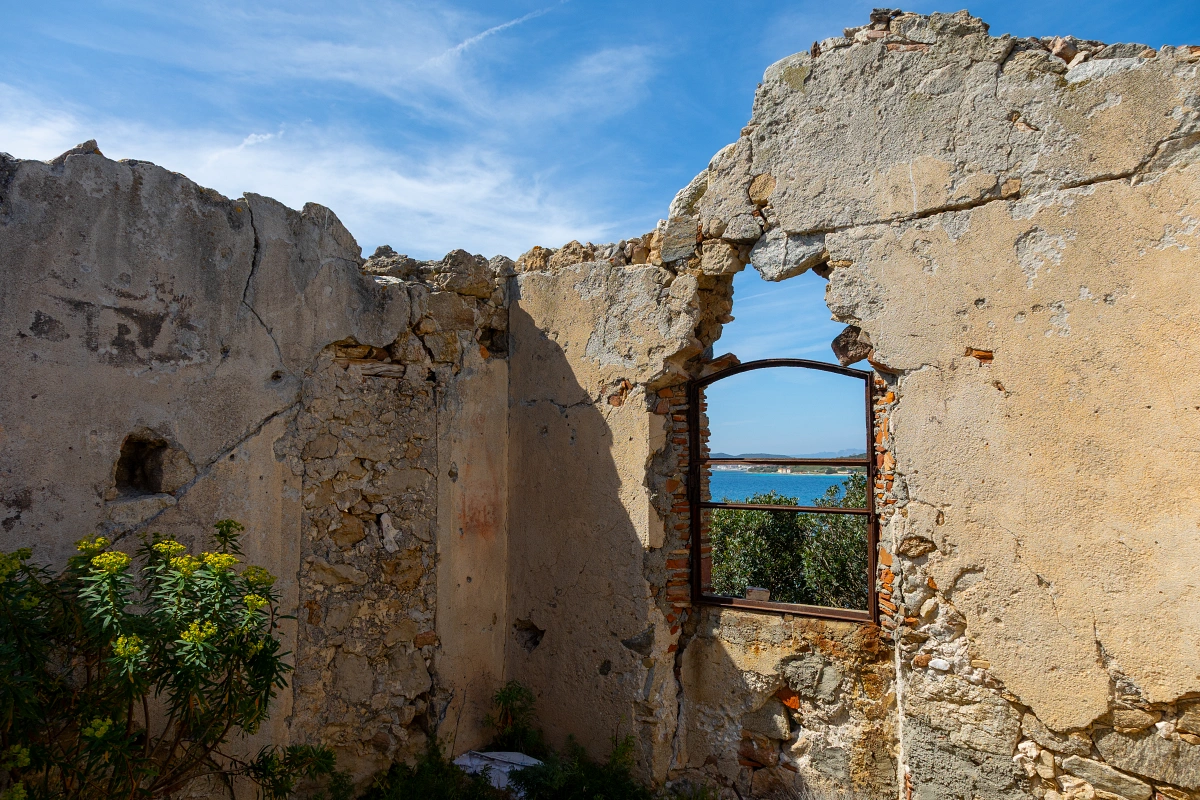
The islet It’s not just nature: it’s also a region steeped in history. Archaeological evidence points to ancient settlements linked to seafaring and trade in the Mediterranean. Its location on the route between Olbia and Etruria This made it a useful landmark for those sailing along these coasts.
Among the most interesting finds are the remains of amphorae attributed to the Phoenicians, dating from 7th century BC. These elements help us to picture an ancient sea, traversed by traders, sailors and shipping routes that linked Sardinia to the rest of the Mediterranean.
Figarolo’s history is thus intertwined with that of Olbia, the coast and the civilisations that have sailed these waters. Even today, when we see it as nothing more than a silhouette on the sea, the island retains a profound memory of voyages, landings and horizons.
What animals and plants live on the island of Figarolo?
The island’s natural environment is unassuming yet surprising. Among the vegetation, one can spot hardy Mediterranean species, adapted to the wind, salt spray and water scarcity. The’wild olive It is one of the most distinctive features, alongside the shrubs and plants that characterise the landscape lush in a simple, unpretentious way, never excessive.
There is also frequent mention of fig trees, an element that evokes the island’s very name and contributes to its cultural imagery. As for animals, the mouflon It is one of the most intriguing sights, whilst seagulls can be spotted in the sky and buzzards. These details serve as a reminder that Figarolo is not merely a photographic backdrop, but a small ecosystem.
The visit should therefore be approached with care: no unnecessary noise, no litter, and no disturbance to the wildlife. Even observing from a distance can be a profound way of getting to know the place, especially when one understands the fragility of an island environment.
What do Cala Sabina, Sabina and Baia Concas Caddinas have to do with a route in Figarolo?
An itinerary focusing on Figarolo can include several stops along the coast. Sabina Cove It is one of the most popular beaches in the area, known for its crystal-clear sea and relaxed atmosphere. The area of Sabina It’s perfect for those who want to alternate between wilder coves and more accessible beaches, striking a balance between exploration and relaxation throughout the day.
Also Concas Caddinas Bay It can form part of a wider coastal route, particularly for those staying in Golfo Aranci who wish to explore more sections of the coastline. Each bay has its own character: some are more accessible, others offer more spectacular views, whilst others are better suited to those seeking peace and quiet and a connection with nature.
Including these stops on the same trip gives you a better understanding of the region’s diversity. Figarolo remains the most iconic viewpoint, but the coastline around it is full of places to explore at your leisure.
What sort of view can you enjoy between Tavolara, the Gulf of Olbia and the north-eastern coast?
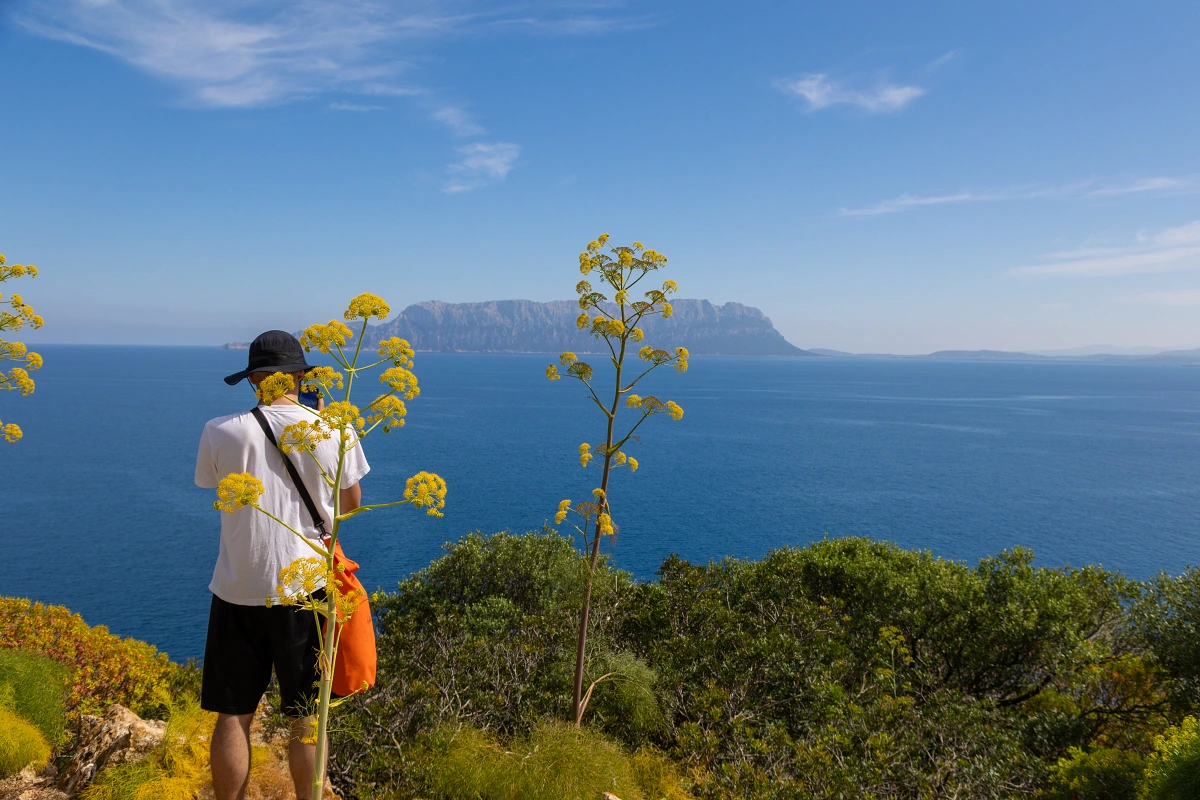
From the vantage points at Capo Figari and from out at sea, there is a sweeping view of the coastline north-eastern. In the distance, it may appear Tavolara, imposing and spectacular, whilst to the south one can make out the Gulf of Olbia. The combination of hills, islands and the sea creates one of the most beautiful views in this part of the island.
The visual relationship between Figarolo and the island of Tavolara It is particularly interesting: a small sea pyramid on one side, a large limestone mountain on the other. Both bear witness to Sardinia’s geological power and the way in which the sea shapes our perception of the landscape.
For photography enthusiasts, the best time is often early in the morning or late in the afternoon, when the light is softer. The sea changes colour, the shadows bring out the shapes more clearly, and the coastline seems to have more depth.
Why is Figarolo an experience to be savoured, combining the sea, kayaking and respect for nature?
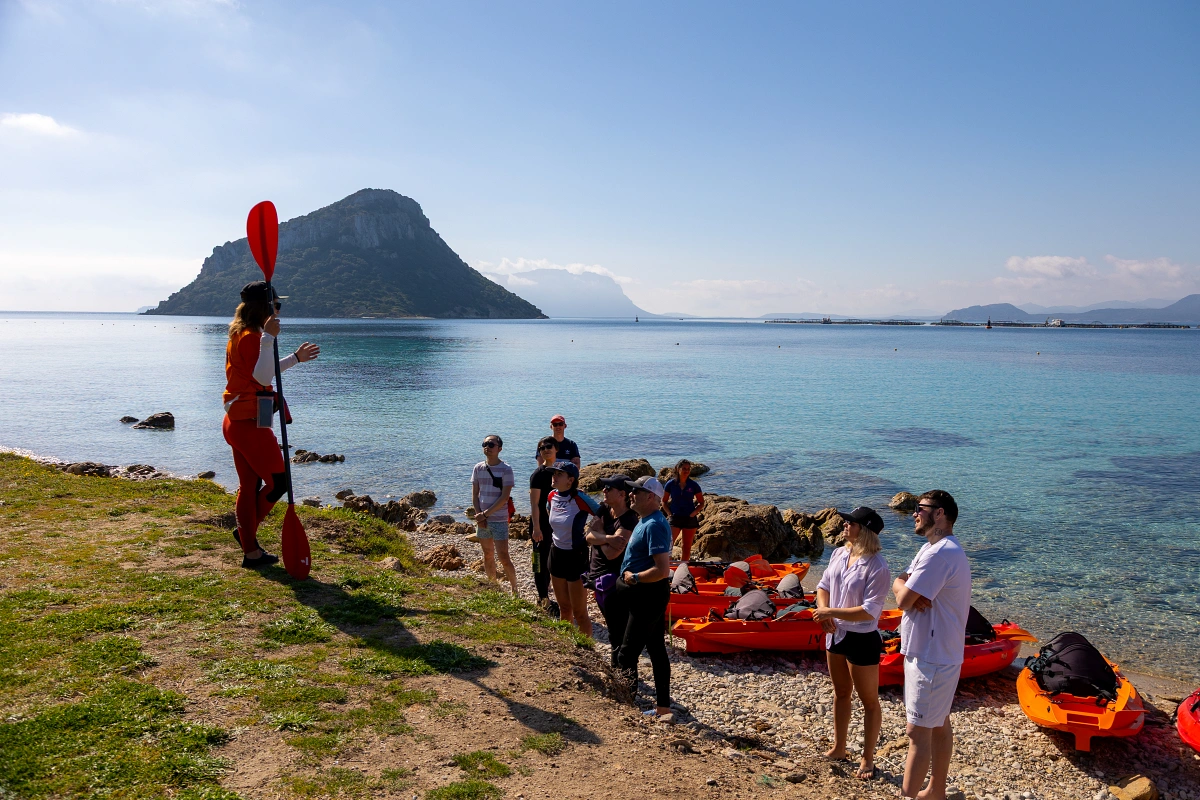
Figarolo It is not a place to be rushed through. Its beauty is best appreciated by approaching it slowly, perhaps on a kayaking trip along the coast of Golfo Aranci. From the sea, you can take in the island’s silhouette, sense the tranquillity of the surroundings and connect with a landscape that changes with every stroke of the paddle.
The area is also ideal for marine wildlife-watching experiences, such as excursions offering the chance to spot dolphins. In such cases, one must always adopt a respectful approach: nature cannot be controlled, only observed. The value of the experience lies precisely in the anticipation, in listening and in the chance to experience the sea at a leisurely pace.
Those who choose this part of Sardinia are not just looking for a beautiful photograph, but for a more authentic connection with the local area. Between Cala Moresca, Capo Figari, Figarolo and the neighbouring bays, every outing can become a tale of the sea, the rocks, the wind and memories.
Summary: What should you bear in mind before visiting Figarolo and Capo Figari?
- Figarolo It is one of the most recognisable natural landmarks in Golfo Aranci.
- The island lies off Cala Moresca and near Capo Figari, in a setting of great scenic beauty.
- Its pyramidal shape and limestone silhouette make it the perfect subject for photographs taken from the sea and from the footpaths.
- It can be reached by sea, usually by small boats or on organised excursions.
- The seabed is ideal for snorkelling and diving, thanks to its rocks, caves, sponges, gorgonians and marine biodiversity.
- The island’s history is linked to ancient trade routes, the Phoenicians and the remains of amphorae.
- Capo Figari offers scenic walking trails, views overlooking the sea and a strong visual connection with the island.
- Cala Sabina, Baia Concas Caddinas and Cala Moresca can form part of a coastal route.
- The best way to experience the area is with respect, at a leisurely pace and with an appreciation of nature.
- A kayaking trip allows you to explore the coastline from an authentic and sustainable perspective.
 IT
IT EN
EN FR
FR DE
DE